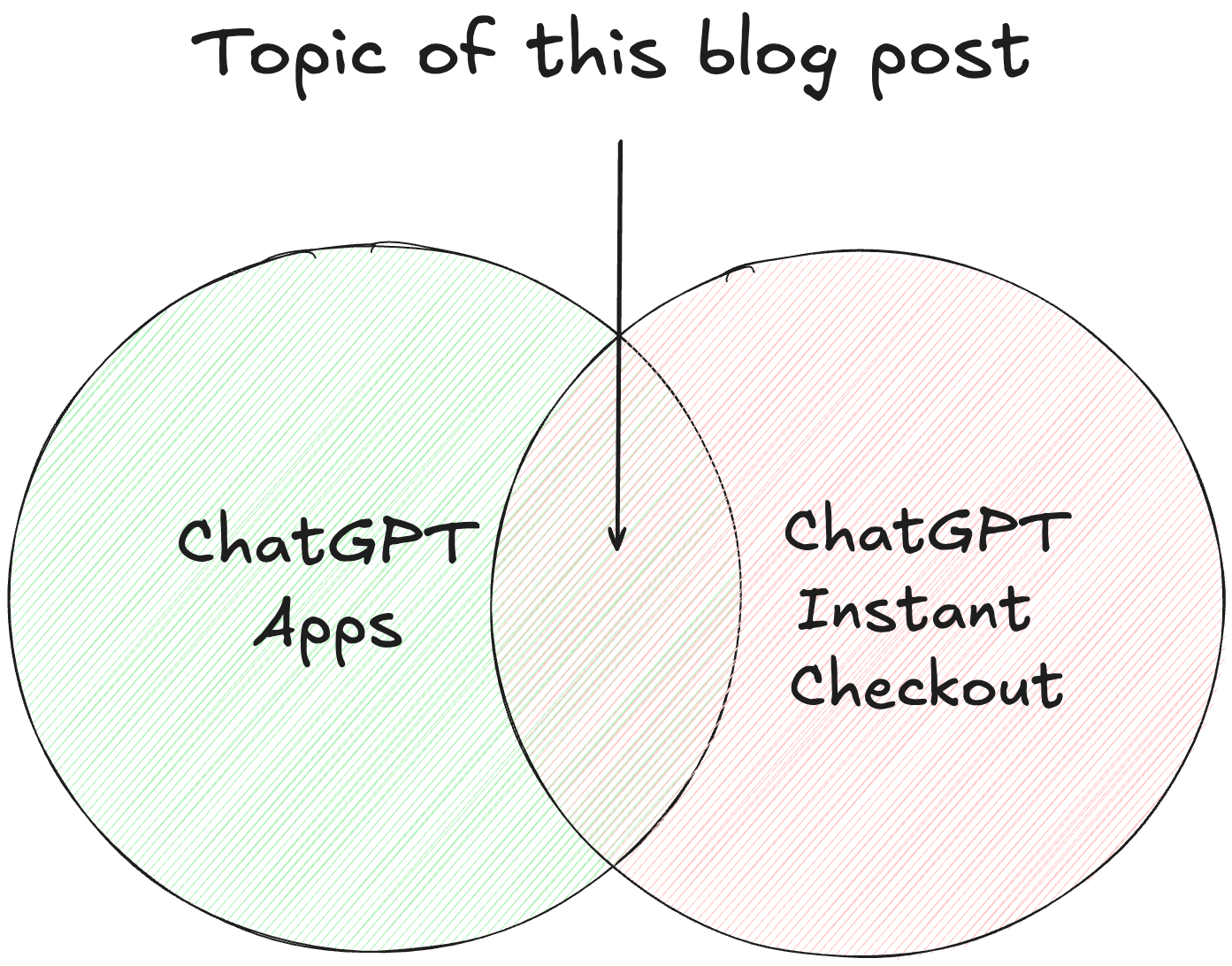
In early October, OpenAI made two major announcements:
ChatGPT Instant Checkout: lets merchants list their products directly inside ChatGPT, allowing users to discover and buy items without ever leaving the chat.
ChatGPT Apps SDK: enables developers to build and publish full-featured apps that can be invoked through conversation using MCP connectors, rendering interactive app interfaces directly within ChatGPT.
Each of these announcements is significant on its own, but what’s especially interesting for us is how they intersect - both touch commerce from different directions. In this post, we want to analyze that interaction, explore what it might mean for merchants, the trade-offs involved, and make some early bets on where things could go next.
How ChatGPT Instant Checkout and ChatGPT Apps Work
Before diving into the implications, let’s look at what each technology does and how users experience it end-to-end.
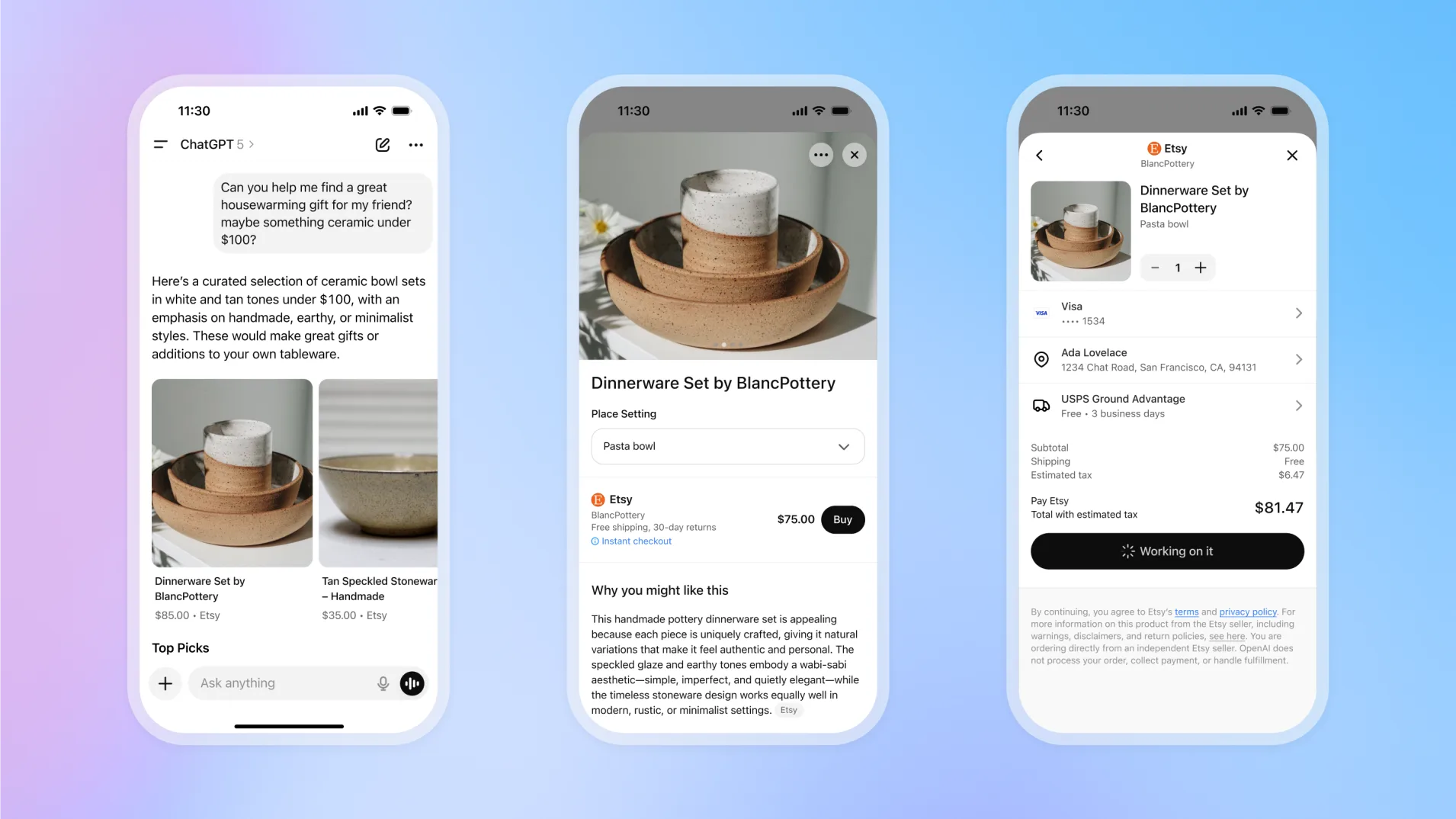
ChatGPT Instant Checkout:
Lets merchants onboard their product catalogs into ChatGPT.
Users can discover and buy products directly within ChatGPT.
Example: User prompts “Can you show me some black XL t-shirts for less than $50?” → ChatGPT renders a product carousel from multiple merchants.
User can tap Buy Now and complete purchase with their ChatGPT wallet.
Merchant remains merchant of record – OpenAI facilitates, but doesn’t own the transaction.
Product rendering logic (carousel, layout, UX) is controlled by ChatGPT, not the merchant.
Merchant integration involves:
Providing a product feed (structured catalog).
Supporting agentic checkout flow (enabling the underlying protocol checkout server, ACP).
The interface is currently one-size-fits-all (unified experience across all merchants).
ChatGPT Apps:
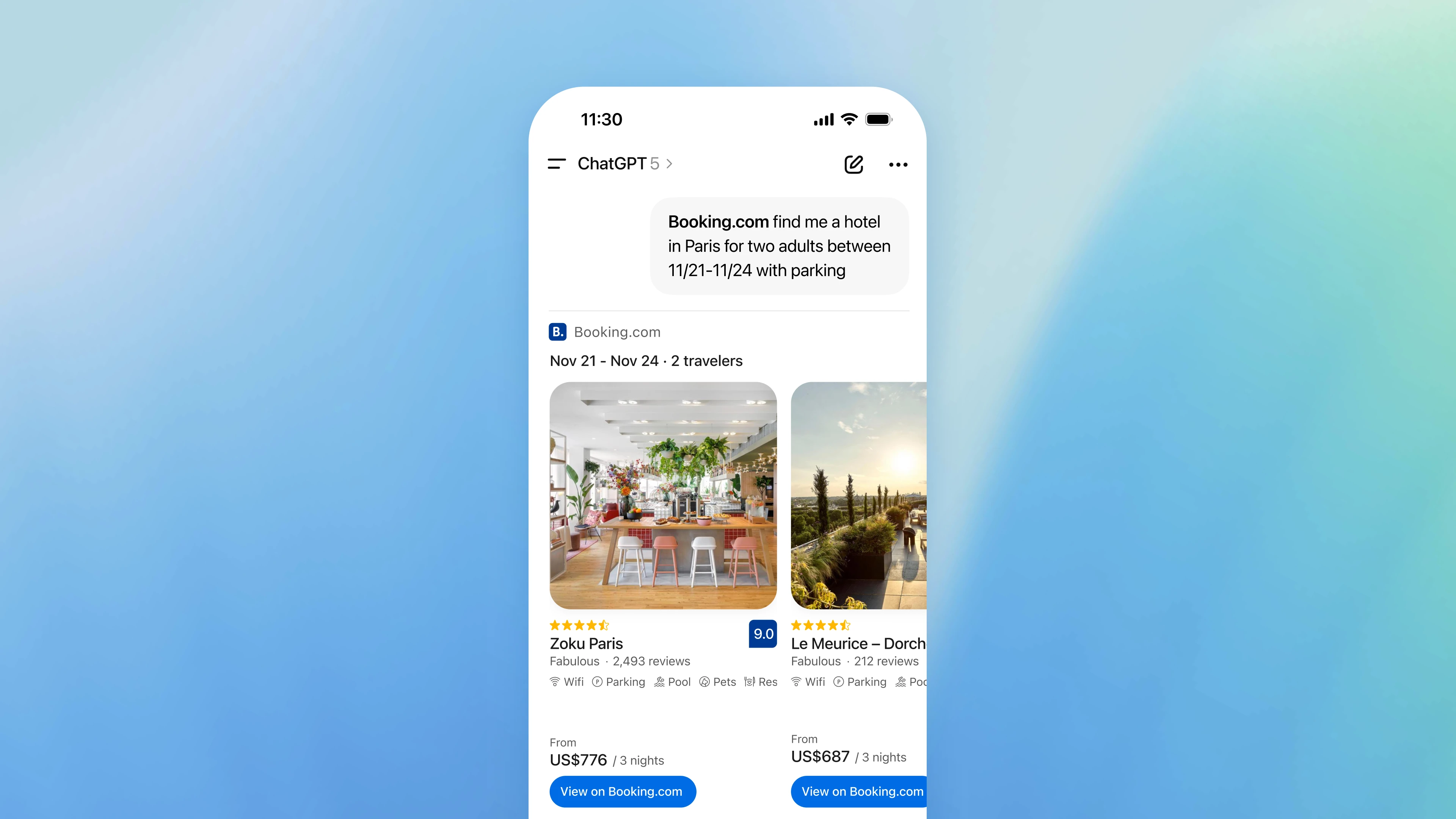
Developers can build interactive apps directly inside ChatGPT.
Apps can include their own interface elements, maintain internal state, and connect to external services through the MCP framework.
Broad scope: can power anything from to-do lists to Uber, calendars, email clients, or shopping.
Checkout flow for apps expected to launch later this year.
Each app defines its own UX and flow – closer to traditional app development (a useful mental model is to think of ChatGPT Apps as a new type of App Store.).
It’s early days for both technologies, but many merchants are already preparing to onboard ChatGPT and are thinking about the various paths forward. Some of them are considering whether they should onboard to the Instant Checkout vs. building a full-blown ChatGPT App.
You might already see how each product might appeal to a different type of merchant. For example, a prompt like “Find me Nike running shoes under $150 in size 10” could trigger both: ChatGPT could render its own native shopping experience showing Nike products, or it could open the Nike ChatGPT App, where the entire shopping journey happens inside the app interface.
This raises a key question: which experience would Nike prefer to optimize for - the standardized ChatGPT commerce flow or its own branded app experience?
Key Tradeoffs
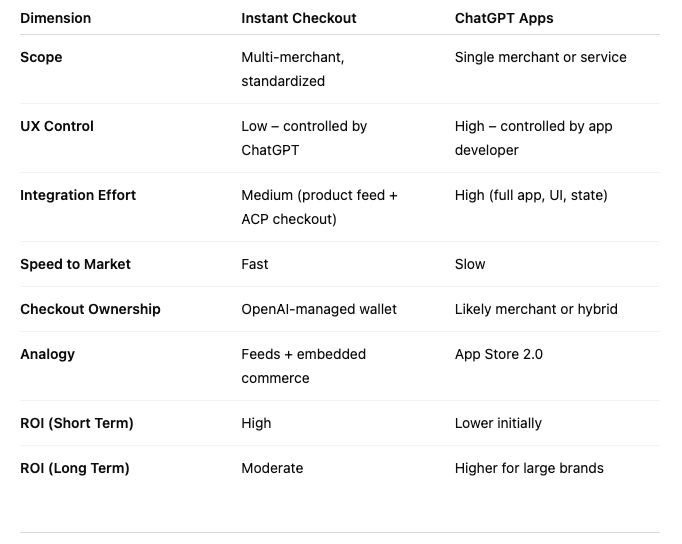
This is a quick analysis of the initial differences we noticed between these two directions:
Exclusivity - Does the merchant need to share the space with other merchants?
Instant Checkout:
Will probably work across multiple merchants in a standardized ChatGPT interface.
Example: A Nike product could appear next to New Balance shoes in the same experience.
ChatGPT Apps:
Designed for a single merchant or service, offering a dedicated, branded experience (there could be aggregators in this category, e.g. Shopify, Booking.com etc.)
More exclusive and controlled compared to the multi-merchant Instant Checkout flow.
UX Control
Instant Checkout:
Limited control – the UI and flow are managed by ChatGPT.
Merchants essentially participate as part of the embedded ChatGPT commerce app.
ChatGPT Apps:
Merchants get full control over design, layout, and user experience.
This is closer to building a complete standalone application.
Integration Effort
Instant Checkout:
Moderate – requires a product feed and an agentic checkout endpoint.
Updating the product feed may take some effort, but you don’t need to build from scratch or rethink existing flows.
ChatGPT Apps:
High – involves building a full application with UI, state management, and backend logic.
Comparable to developing an app for a new kind of app store.
Just like mobile apps today have dedicated Android and iOS teams, ChatGPT Apps may evolve into their own category, requiring specialized expertise.
Speed to Market
Instant Checkout:
Medium – plugs into existing ChatGPT infrastructure.
ChatGPT Apps:
Slower – requires full app development and testing.
Analogy
Instant Checkout:
Feels like embedded commerce or feed-based shopping.
ChatGPT Apps:
Closer to a new kind of app store, with deeper control and customization.
Key Distinctions Summary
Identity / AuthN
There’s also an important point around identity and authentication. Currently, there’s no dedicated authentication flow in ChatGPT Instant Checkout, which means the merchant doesn’t really own the user relationship (they receive the user name and email from ChatGPT within the ACP protocol data exchange, but the canonical identity source is ChatGPT). Instant Checkout abstracts merchant-specific authentication and assumes a universal user identity across merchants. In contrast, Apps could have their own MCP-based authentication flow. They need to manage sign-in and identity at the app level (there is obviously room here for OpenAI native auth flow as the identity provider).
As a result, Instant Checkout keeps most of the user data and relationship at the ChatGPT platform level, while Apps give brands more control over identity and direct customer connection
ChatGPT’s Commerce Dilemma
An interesting angle that would be interesting to follow is internal competition within ChatGPT. The platform itself will need to decide when to trigger an app versus the instant checkout interface. For example, if someone builds a sports app and a user asks for “running shoes,” does ChatGPT launch its own commerce flow or open the sports app instead?
This creates a new kind of internal platform tension - between ChatGPT’s standardized commerce and app-based commerce. Users might be prompted to choose, but given the stakes, it’s likely that ChatGPT will eventually lean in one direction.
What Fits Whom
Our current initial intuition is that ChatGPT Apps are best suited for large, premium brands:
Big brands have the resources and teams to design a full in-chat app experience from scratch.
They tend to value control.
Premium or exclusive brands (like fashion or luxury labels) often avoid being “blended” with others. Brands such as Aritzia, still don’t list their products on Amazon or marketplaces for this reason.
They want to communicate exclusivity and maintain a direct brand relationship.
If we use the App Store analogy, most shopping doesn’t happen through individual brand apps - it happens through aggregators and marketplaces. Brand-owned apps are mainly about relationship and loyalty, not discovery. The same dynamic may play out here: Instant Checkout will drive broad discovery and sales volume, while Apps will serve as premium, controlled environments for top-tier brands.
Closing Thoughts
Both ChatGPT Instant Checkout and ChatGPT Apps point toward the same long-term direction: commerce that happens inside conversation. But they represent two very different approaches to getting there.
Instant Checkout will likely power the first wave - fast to adopt, standardized, and optimized for reach. Apps, meanwhile, will define the premium layer, where brands can build richer, controlled experiences.
OpenAI has mentioned that they will publish the checkout guidelines for apps later this year. It will be interesting to see how close it is to Instant Checkout and how much they control vs. give to the merchant (Apple historically controlled the checkout for App Store applications until this year).
Either way, the foundations for agentic commerce are being laid right now - and merchants that start experimenting early will be best positioned when the platform matures.
If you have questions about implementing ACP checkout for your ChatGPT app or Instant Checkout integration, or if you want to build a commerce agent with an agentic wallet that can handle payments - reach us anytime at [email protected].
Subscribe to get the most up-to-date analysis of agentic commerce.