Yesterday we saw another major announcement for agentic commerce from Google (and it’s only January):
Google Agentic Commerce Timeline:
Jan 11: Launched Universal Commerce Protocol (UCP) at NRF conference
Jan 28: Chrome gets Gemini 3 + Auto Browse with native UCP support for agentic shopping
Yesterday’s announcement means Google is officially joining the “browser wars” - following Perplexity Comet, OpenAI Atlas, Microsoft Edge, plus a long tail of competitors launching either agentic browsers or agentic browser extensions (like Anthropic’s browser extension).
This is probably the biggest announcement in the agentic browser wars so far, for three reasons:
Chrome has 3.5–4 billion users and roughly two-thirds of the global browser market share
Gemini in Chrome is integrated with G Suite from day one - email, calendar etc.
Google authored UCP, giving them a unique opportunity: they can incorporate the protocol directly into the browser. OpenAI could theoretically do this with their standard (ACP), but their agentic browser Atlas doesn’t have the distribution. Google holds both ends of the stick. More on this below.
Let’s cover the experience first, then the agentic commerce angle - which is big.
Gemini in Chrome
The gist: just like other agentic browsers, this is a side panel that lives natively in the browser. You can “talk” to it to interact with web pages in several ways:
The page you’re currently browsing.
Example: “summarize this article for me”
Open tabs
Example:“Compare the prices across my open shopping tabs”
Surfing the internet on your behalf (likely using Gemini’s native search capability)
Example: “Find me the best-reviewed Italian restaurants near me”
More complex operations through a feature called Auto Browse - which can click on pages and actively perform operations like adding items to cart, comparing products, and more. This is basically ‘agent mode’ for the browser where it comes up with a plan and executes on your behalf, including clicks, navigation etc.
Example: “Fill out this job application with my resume info”
If you’ve used Perplexity Comet, the experience is probably pretty similar, at least at the feature level.
There are also some really cool Nano Banana features you can use directly inside Chrome. We won’t cover them here in depth, but they open up new consumer modalities that will likely converge into agentic commerce as well. For example, you can prompt Gemini to redesign a living room based on a photo, or turn raw research visuals into polished infographics. In the blog they even show examples of editing and reimagining a room image instantly.
This is the example they give:
“Show me this room with light contemporary furniture”
You can see how this easily translates into commerce: "Now create a cart with all these items" or "Find me similar pieces I can actually buy." Visual inspiration becomes a shopping list in one step.
Agentic Commerce Angle
When it comes to agentic commerce, we see browser capabilities falling into two buckets: passive and active.
Passive is using it for things like comparing prices across tabs, pulling reviews, fetching product specs, or advising which product is the better buy. Think of it as ChatGPT, but with the context of your browser. It can help you in the discovery phase or when you’re analyzing what to buy - pretty much what people are already doing with ChatGPT, just living natively inside your browser now.
Active is when the browser actually does things for you - clicking, navigating, filling forms. This ranges from simple stuff like checking hotel availability for specific dates, all the way to complex searches, or even completing a purchase on your behalf.
But not all actions are equal. We think about active operations in three risk tiers:
Low-risk: Technically an action, but the goal is still information consumption. Clicking dates to check availability, checking prices, comparing options. Nothing irreversible - just saving you time on exploration.
Medium-risk: The agent starts acting on your behalf. Adding items to cart, especially when logged in. You’re inside an authenticated session now, and actions carry weight. Still reversible, but you’re halfway to checkout (this is the example they give in Google's blog, where the AI adds items on Etsy to your cart and then stops for review).
High-risk: The real thing. Clicking buy. Completing a purchase. Real consequences, with real risk of mistakes. This is the holy grail - but also the hardest, requiring serious infrastructure and guardrails.
Where Does UCP Fit In
Now the most interesting part. Here’s what Google wrote about UCP support:
“Finally, Chrome will support Google’s Universal Commerce Protocol (UCP), a new open standard for agentic commerce co-developed with industry leaders including Shopify, Etsy, Wayfair and Target. This new open standard ensures that AI agents can take actions on a user’s behalf seamlessly in Chrome.”
For what we categorized as active + high-risk operations (i.e., buying), UCP is the protocol that enables an agent to purchase directly from the conversation side panel. We call this conversational checkout.
Amazon added exactly this with Rufus back in November - they added “Buy now” and “Add to cart” directly inside the conversation. This is how it looks like in Amazon app:
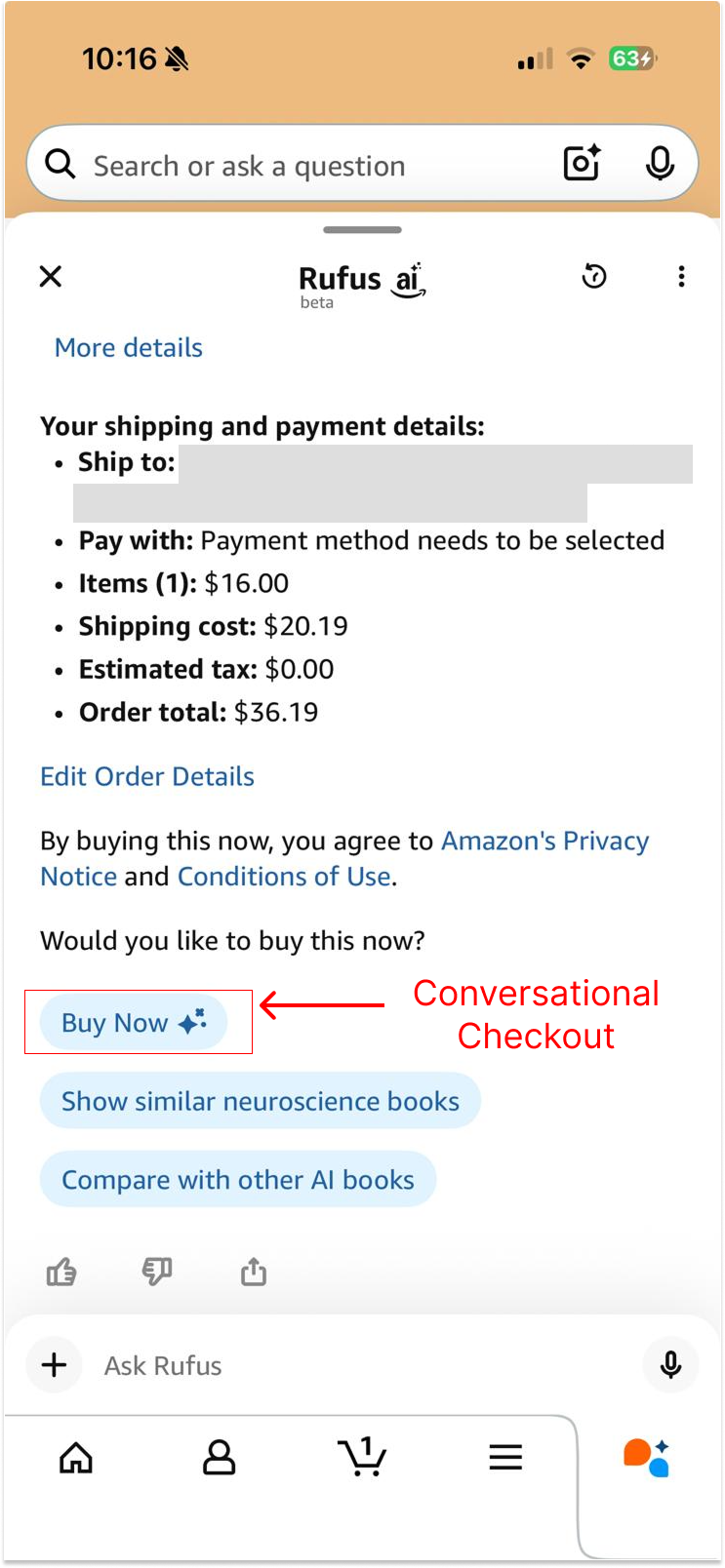
And it doesn’t have to be super agentic. It’s not about telling the agent to “go autonomously run around the web.” It’s simpler than that. It’s literally moving the add-to-cart into the conversation, and then the buy button into the conversation. And once you do that, the natural next step is autonomous payments and fully agentic commerce - the more futuristic version.
The relationship to UCP is that UCP enables having the 'buy button remotely and not directly within the web storefront.
With UCP, every participating website exposes a structured endpoint. That endpoint describes the site’s capabilities - including how checkout works. Instead of the browser scraping pages and interacting with unpredictable checkout flows, the logic shifts away from the website UI and into a structured backend.
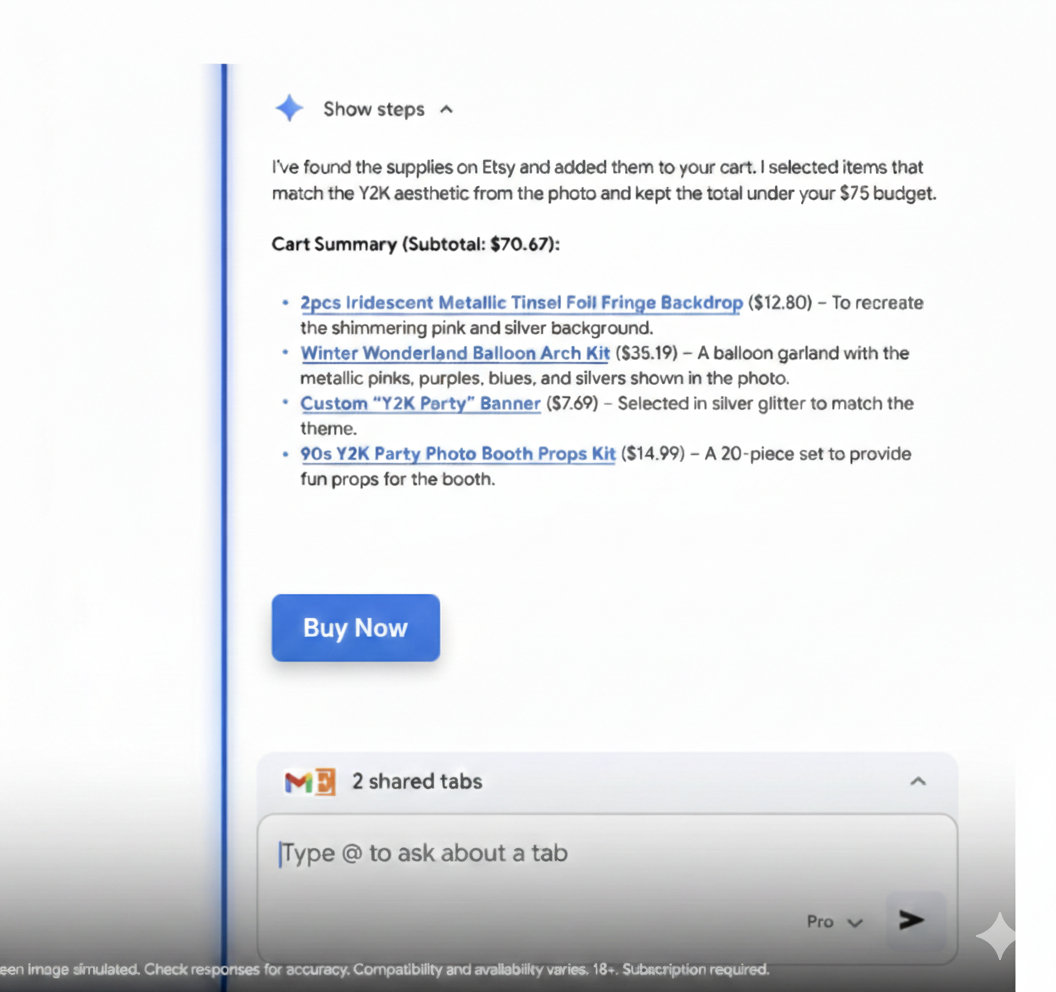
The browser is no longer “clicking through checkout.” The conversation becomes checkout. We asked Nano Banana to add a ‘buy now’ button into Google’s side-panel and this is how it could look like:
Where Does Google Pay and Payments Fit in
We found more clues pointing toward agentic commerce infrastructure. This is from their blog:
“And if you give Auto Browse permission, it can use Google Password Manager to handle tasks even if a sign-in is required.”
Google Password Manager, together with autofill, already provides a local vaulting service for passwords and payment credentials. What Google is saying here is that the AI agent will have access to those credentials - it can log into services directly on your behalf.
This is the path toward agents executing high-risk operations safely. And Google Pay fits very, very nicely into this picture. That is also how Google can tokenize the payment credentials according to the UCP spec, and send a payment token to the UCP endpoint when the user clicks ‘buy now’.
The natural continuation for Google Pay is that it becomes the wallet layer for all their AI surfaces. You have one Google Pay wallet that sits across all Google AI surfaces:
One wallet for Gemini
One wallet for Gemini inside Chrome
One wallet for AI Mode in Search
It becomes the consistent payment identity across the entire AI experience.
Putting It All Together
Google is quietly assembling all the pieces needed for end-to-end agentic commerce.
They have the distribution - Chrome’s 3.5 billion users now get Gemini embedded natively in the browser
They have the protocol - UCP provides a structured way for agents to interact with merchants without scraping or brittle UI automation (and with many merchants already onboarded to Google Shopping, plus onboarding right now to be able to be found on Gemini)
Identity and payments layer - Google Pay and Password Manager can serve as a unified wallet across all their AI surfaces
What this adds up to is a seamless path from conversation to checkout to payment, all happening inside the browser side panel. Discovery, decision-making, and purchase start to collapse into a single interface.
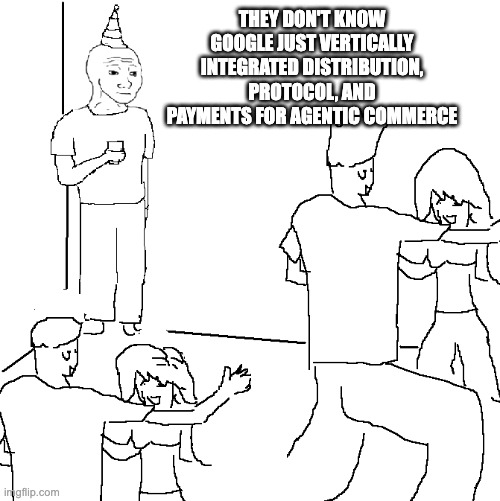
No other company currently holds all three pieces at once.
Thanks for reading! If you want to keep receiving updates and strategic analysis about the frontier of agentic commerce, feel free to subscribe below:
Plus another friendly reminder - we’re holding an Agentic Commerce Webinar with Worldpay and RefiBuy. We’ll cover the new protocols, payments, catalog work, and more. If you want to stay on top of the frontier, you should come listen. Subscribe here.