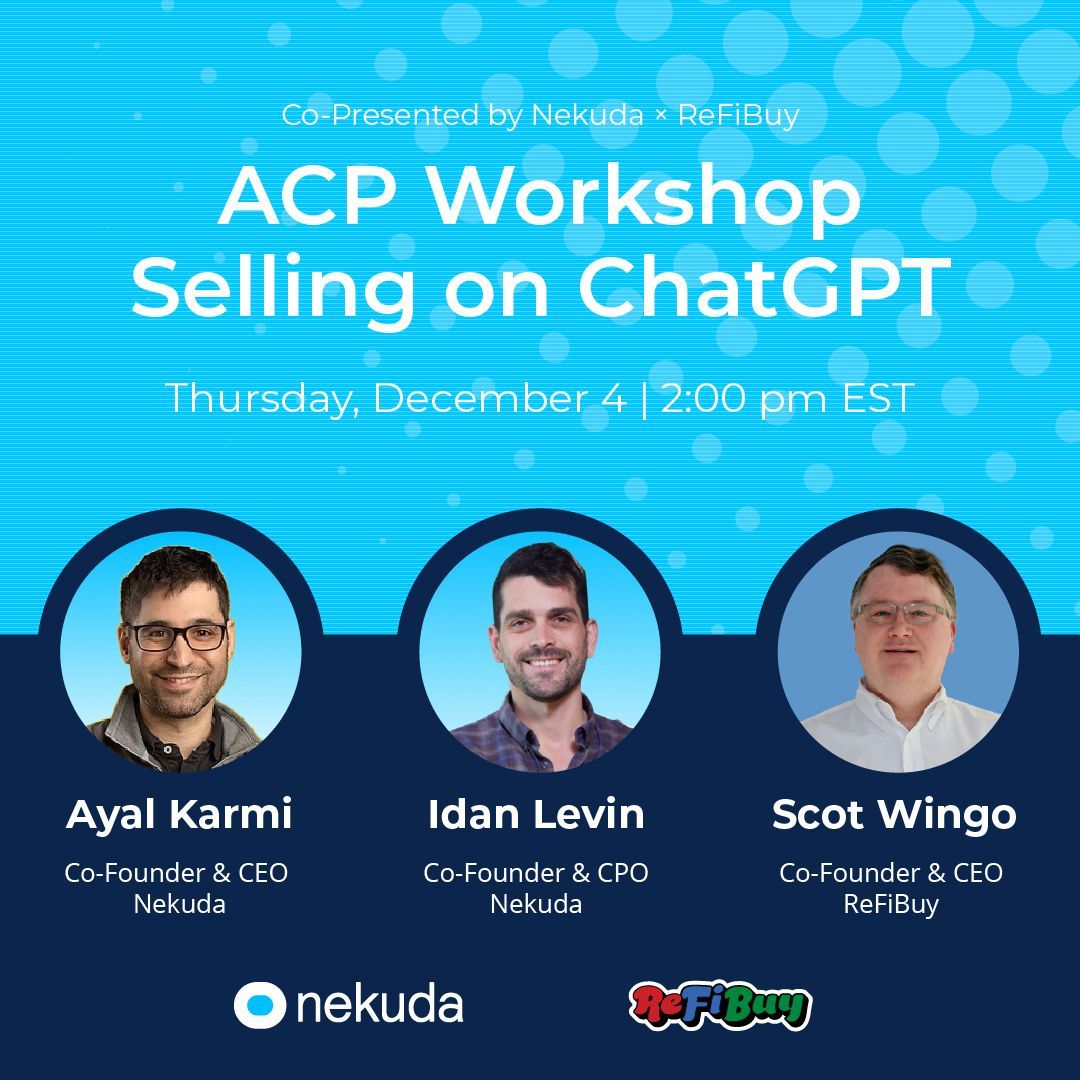
🚨 This Thursday we’re co-hosting a workshop with our good friends at ReFiBuy about Selling on ChatGPT. Scot from RefiBuy will discuss product data optimization and the product feed, and we’ll give a technical review of Agentic Commerce Protocol (ACP) checkout. Make sure you sign up here.
We also wanted to take this chance to recap the status of ChatGPT Instant Checkout / ACP, share updates, and address the key gaps we keep getting asked about.
ACP Staus:
✅ Etsy is live.
✅ Shopify is live with select merchants like Glossier, SKIMS, Spanx, and Vuori.
✅ Walmart is live (as of yesterday!)
✅ Target app is live, but ACP checkout isn’t implemented yet (it currently redirects to Target’s website checkout). Just as a reminder: OAI has announced that ChatGPT Apps will also use the same ACP checkout, and that guidelines will be provided soon.
The experience with ACP is still a little buggy. A few current issues users are reporting:
Missing variant data and bugs in the variants UI.
Checkout often doesn’t trigger (you click and nothing happens).
Hard to find purchasable products (this might be on purpose - things are early, and OAI probably doesn’t want to hit the gas too hard yet).
With that said, this is incredibly exciting as we are seeing the first inning of agentic commerce at scale. It’s not easy onboarding retailers with millions of SKUs into a third-party checkout, and the bugs make sense for v1. For us we can’t stop thinking of the first App Store - a new distribution channel is forming and every new merchant that goes live is a small piece of history.
ACP Governance Update:
Without any public announcement, a major pull request landed in the ACP GitHub repo last week. The PR was just merged yesterday and includes:
A governance document
A mission and principles document
SEP guidelines (SEP = Specification Enhancement Proposal - the process for proposing improvements that get integrated into the protocol)
Some interesting things to highlight -
Mission
The Agentic Commerce Protocol (ACP) exists to promote open, secure, and interoperable commerce between agents, payment providers, and sellers. Our mission is to advance adoption and real-world use of ACP as a neutral, open standard that evolves rapidly alongside the pace of AI while maintaining trust, safety, and technical integrity.
The governance document is also interesting. It defines a “founding maintainers” tier, which includes OpenAI and Stripe. They hold the final decision-making authority for the spec. It also defines a “maintainers” tier for future organizations that will be admitted in later governance revisions. These will be added over time. There are currently three founding maintainers from OpenAI and three from Stripe.
Changes to the protocol are governed through SEPs (Specification Enhancement Proposals), following the same model used by Anthropic’s MCP protocol. SEPs cover protocol changes, new features, process updates, and any proposal substantial enough to require community review. Anthropic’s MCP open-source community was formed just a year ago, and has hundreds of active contributors, from individuals, startups and corporations. This shows how big this could get eventually and how quickly a shared protocol can become the default integration layer when enough builders align around it.
We need to remember how important ACP can become - right now it powers ChatGPT’s instant checkout and is expected to power ChatGPT Apps. But it could easily become the core building block that lets merchants sell through agents, AI apps, and many other types of applications (we will wait and see if Google and Microsoft will adopt ACP or will try to come with their own standard).
There has never been a successful, widely adopted API checkout standard in e-commerce that is this interoperable. The massive user base of ChatGPT gives merchants a strong incentive to adopt ACP and seed the infrastructure needed for agentic commerce.
Some Improvements ACP Checkout Might Need
We were asked by various people what should be improved first in ACP checkout. So we wanted to share some of our thoughts here, obviously there will be a v2, v3, and there are a lot of things you could imagine going into the protocol.
There are the obvious improvements we heard a few times already:
A stateful shopping cart, vs. a single line item right now (trivial to implement)
Multi-merchant support (not trivial to implement from a UX perspective, as users buy from different Merchants of Record and it could easily become confusing).
But then there are the three important changes we see as most important:
Authenticated checkout flows
Most large retailers and brands rely on authenticated flows on their websites. You pay with a known identity, not just a guest checkout. This is the foundation of loyalty, personalization, and repeat buying. For retailers like Walmart, this is a core part of the business.
So ChatGPT users will need to authenticate with the retailer or brand as well. ACP should probably offer two clear flows: authenticated checkout and guest checkout.Upsells
Upsells are the bread and butter of commerce. Every modern checkout offers an upsell opportunity in the form of recommendations. This gets even more interesting in the ChatGPT environment because the platform is clearly looking at the ads opportunity.
There are a few possible paths here - OAI could sell the upsell slots the way Google monetizes search results or Amazon monetizes recommended sellers. So after you add to cart, OAI might withhold the data from the merchant, tag the upsell opportunity, and auction it to the highest bidder. In that model, the upsell isn’t even tied to the specific merchant by default.
Here is an example of a context object that could represent an upsell auction opportunity (merchant will auction to buy the upsell slot based on this information):upsell_context: event: “post_add_to_cart” session_id: “abc123” timestamp: “2025-03-27T10:42:11Z” product_context: primary_item: id: “p-9021” name: “Sony WH-1000XM5” category: “electronics.headphones” price_usd: 349 user_intent: inferred_intent: “premium_audio” price_sensitivity: “medium” urgency: “low” brand_affinity: [”sony”, “bose”] cart_snapshot: subtotal_usd: 349 items_count: 1 previous_purchases: [”electronics”, “accessories”] merchant_context: origin_merchant_id: “m-10483” allows_upsell_competitors: true prohibited_categories: [”adult”, “gambling”] slot_details: slot_type: “post_cart” format: “card” restrictions: max_response_time_ms: 120 max_characters: 300 auction_tags: opportunity_type: “cross_sell” recommended_categories: - “electronics.accessories” - “protection_plans” risk_flags: low_risk_user: true address_verified: true payment_method_verified: falseThis also raises a bigger question: how much user data does OAI share with the merchant? Especially in authenticated flows, where customer identity drives long-term value and future offers across channels outside ChatGPT. There is a spectrum here between the merchant knows nothing (probably not reasonable) and the merchant knows everything (probably not reasonable as well). The question where will it land is fascinating.
We recently heard a great podcast with Sean Frank from Ridge saying that Gemini plans to share more data with merchants than OAI (recommended listening to those tinkering with how ads will work on ChatGPT). We don’t know if that’s accurate, but if it is, it shows the real tradeoffs and the delicate details at stake here.Better risk handling
Today, risk signals from the client (ChatGPT app, agent apps, etc.) are only sent to the Payment Processor (e.g. Stripe) through the delegate payment endpoint, when payment token is created. The ACP checkout endpoint doesn’t receive them at all.
In this model the Payment Processor is handling all the fraud logic. It works fine for players with strong fraud capabilities, but it breaks how many merchants already operate today - A lot of merchants plug directly into their own fraud providers. We also try to think about the case of Payment Gateways which starts to become really complex as they will need to route the payments. A simpler model might be that the ACP checkout to also receive these signals so merchants can keep using their existing fraud stack without changing their architecture, plus not rely entirely on the PSP.
These are our early thoughts, but if you have more ideas feel free to send them through, we love to geek out on protocols.
Join our ACP Webinar!
Hope this convinced you to join our ACP webinar this Thursday (sign up here). In the meantime, if you want to learn more about agentic commerce and payments, make sure to subscribe.