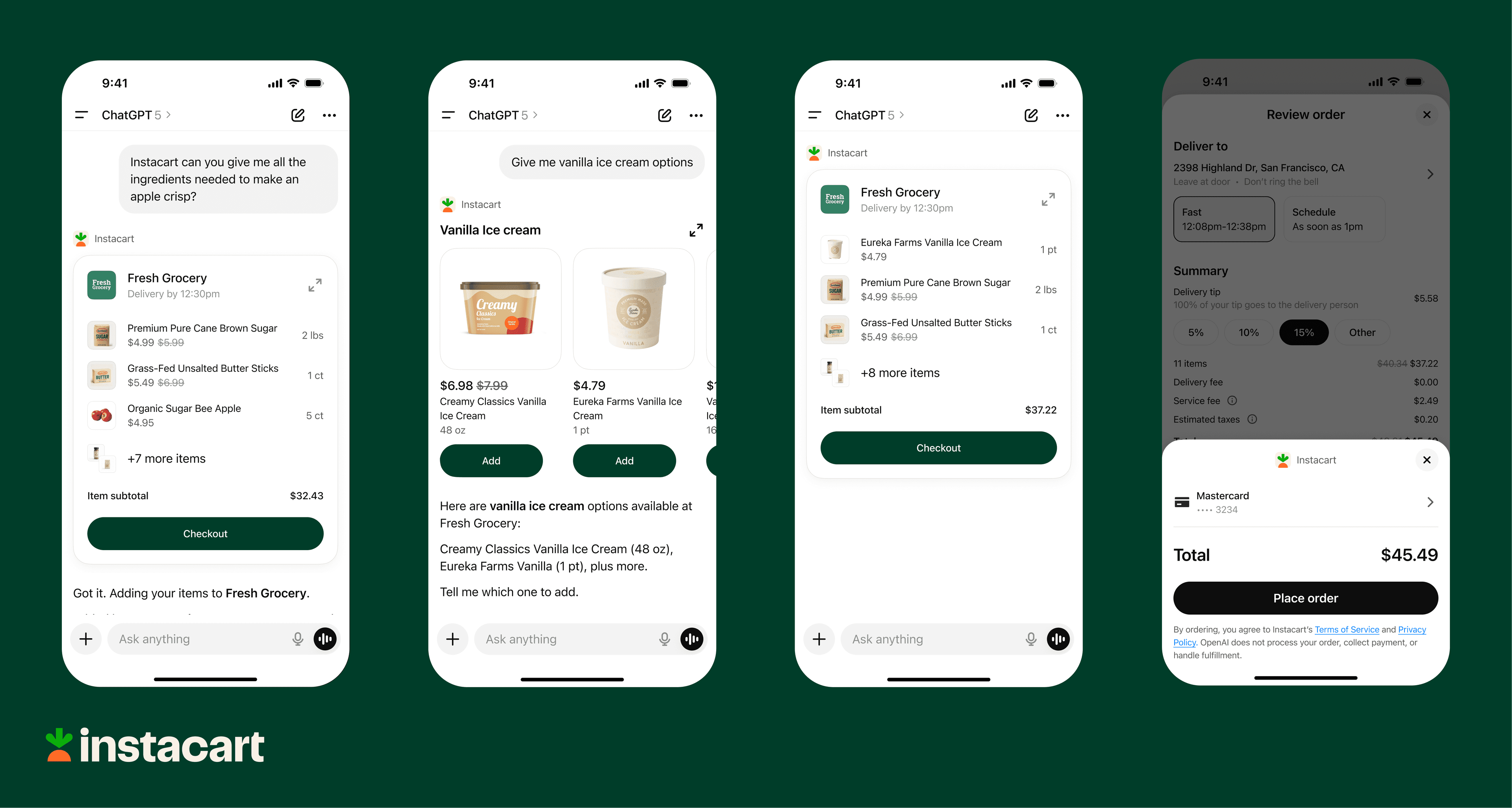
ChatGPT and Instacart released yesterday their new app integration - an Instacart app you can invoke directly inside ChatGPT. You can add items to your cart using text, edit your cart via text or visual UI with button clicks, check out with an ACP checkout implementation (which we’ve been mentioning a lot), and do all of that without ever leaving the ChatGPT interface.
Scot from RefiBuy showed a great walkthrough in his blog. He asked ChatGPT for a pecan pie, and ChatGPT (i) figured out the ingredients needed (ii) automatically added all the items to the cart via the Instacart app (iii) paid via an integrated ACP checkout.
This is very cool because it combines the intelligence of the LLM - figuring out what ingredients are needed - with an app that does the operational lifting and fulfillment. It gives the user real flexibility because you can just describe what you need or want and it works. You want low fat milk? You want to tweak the recipe to be a bit healthier? The whole thing updates in Instacart straight from text, instantly. Like a genie in your pocket.
The experience is smooth and unique. We believe this is a real breakthrough - it opens up a new way to interact with services via text and visuals (OpenAI is integrating the new MCP-UI standard for rendering UI components directly in chat), buy and order items, discover products, all using an intuitive chat interface and without leaving one app.
Without getting too cliché, ChatGPT Apps feels like a sleeping giant. While everyone else is arguing about Gemini 3 and the foundational models, we believe the real competition will shift to the application layer on top of chat interfaces, not the underlying LLM. The LLM layer itself is already getting commoditized by Chinese open-source models that are catching up fast.
We want to take the chance and share some early strategic thoughts about the Instacart app and ChatGPT Apps in general, because you can already see a lot of downstream effects from this single release. The success of ChatGPT Apps will trigger major strategic shifts across e-commerce merchants, and digital service providers.
Switching Costs to Zero?
In the past, if you were a company like Instacart, you had a mobile app and a web app - that’s how you engaged most users. Companies spent a lot of resources to get users to download the app or log in via web, and then retain them.
Distribution and app development were a huge deal and there’s a lot of science behind it. Getting a place on a user’s iPhone home screen was one of the hardest pieces of real estate to capture for a long time, and this creates consumer stickiness that is hard to break.
ChatGPT now owns the distribution in that space. They decide which apps get surfaced and which don’t, basically replacing the role of the app store. But now you don’t have the downloading step (you just invoke by text), which used to be a big friction point. That alone opens a major design space for OpenAI because users can switch between apps much more easily.
In the future, maybe you won’t just search your Instacart app. You could search across multiple apps at once, which weakens Instacart’s moat because users can compare options with almost no effort.
Consider this prompt:
“Please find me a taxi to the airport from Manhattan. Go through all the ride-sharing apps (Uber, Lyft, Via, Waymo, etc) and find me the cheapest option.”
To do this technically, I used to need to download all the apps and open them in parallel, which is a hassle no one actually does. ChatGPT Apps collapse the walls between these services at a fundamental level. More power shifts to the user, and less to the business behind each app.
There’s no non-dramatic way to describe it. This changes the balance of power between users, OpenAI, and the app providers.
But this is only the beginning, because there is something much bigger happening here - data, data, data.
Who Owns the Relationship Now?
In the old world, if you downloaded the Instacart app, everything that happened inside it was a silo owned by Instacart. Instacart owned the user relationship and the data. Apple or Google only knew that you downloaded the app and maybe some light usage metrics. The real data lived with the app provider.
ChatGPT apps break this model. A lot of the early interaction and intent now lives with OpenAI, not the app.
Take the pecan pie example. First I asked:
“Give me a recipe for pecan pie and make it a bit healthier.”
ChatGPT does the work here. It figures out the ingredients, maybe tweaks sugar or fat, and only then decides to involve Instacart to turn the recipe into a cart. The whole conversation that led there - my intent, constraints, preferences, follow-up questions - sits with ChatGPT, not Instacart.
This has real implications for ecommerce and digital goods.
The user intent is with OpenAI.
The historical context is with OpenAI.
The decision to route to Instacart vs any other app is with OpenAI.
So what happens to classic playbooks like:
How a merchant offers upsells
How discounts and coupons are targeted
How a customer is treated based on past behavior
If someone else owns the intent and the interface, the merchant is suddenly downstream from the real customer relationship.
The OpenAI Data Flywheel
This also creates a strong network effect for OpenAI:
More apps means more users using ChatGPT as the entry point
More users means more intent and preference data flowing into ChatGPT (and stored as memory)
More data means better personalization and better results when you use apps through ChatGPT
That, in turn, makes developers want to build more apps on ChatGPT, because that is where the happiest, most understood users are. ChatGPT becomes a ‘context-as-a-service’ business, which ‘loans’ the user data to the app. And we don’t know what is the price of this loan yet.
The center of gravity moves from the app to the interface that controls intent.
Oh, you think this is it? Oh man. Not yet. There are some more surprises :)
One App. One Checkout. One Wallet.
Here’s the next shift that most people haven’t processed yet -
When you buy through the Instacart app inside ChatGPT, you’re not using Instacart’s payment vault anymore. You’re using the card you already added to ChatGPT. The payment method lives at the ChatGPT layer, not the merchant layer.
ChatGPT becomes the source of truth for payments.
You can add PayPal or Stripe Link, a credit card, whatever wallet and payment method you want. But the wallet UI and vault is owned by ChatGPT. This reduces friction for the end user and makes it easier to buy things. But it also reduces the app provider moat, because they used to own the payment and checkout process.
ACP Checkout as a Building Block for Agentic Commerce
The Instacart app uses the ACP checkout implementation. This is already the second real use case that treats ACP checkout as a building block, not just a one-off feature.
In the workshop we did with RefiBuy last week about ACP (you can watch the recording here), we talked about this exact point: ACP is not only about powering instant checkout inside ChatGPT. It is a reusable primitive for future agentic commerce use cases.
Every time a new app integrates ACP, it is not just “adding a payment button.” It is plugging into a shared checkout standard that agents can learn once and reuse across many merchants and apps.
Keeping Your Sovereignty as a Business
ChatGPT Apps introduce a new type of experience that is simply better for end users than anything we’ve had before. That has the potential to drive massive growth, but it also forces merchants and service providers to rethink user acquisition, marketing, and how they build a relationship with the customer. There are a lot of new questions here, and we’re excited to see how this future unfolds and to help solve these challenges.
In all these sections we see the same pattern: ChatGPT creates an amazing experience for users, but some of the price will be paid by merchants and service providers. If you’re user-centric, you know the equilibrium usually lands with the end user. That’s how platform shifts work. So the right in our minds is to accept this early and look for new angles of leverage instead of fighting the gravity.
We believe the businesses of the future need to seize the opportunity and jump on the wagon, while also asking the hard questions and preparing an “immune system” that maintains merchant sovereignty. ChatGPT is incredible, but it won’t be the only platform. Others will emerge with different tradeoffs. The intelligent merchant will learn to navigate this evolving ecosystem and use it to grow, not lose control.
If you have questions about implementing ACP checkout for your ChatGPT app or Instant Checkout integration - reach us anytime at [email protected].
Subscribe to get the more strategic deep dives of agentic commerce.