Every business - holding company, retailer, brand, small merchant - is already planning its 2026 agentic commerce strategy.
Over the past months, we’ve had dozens of conversations with merchants and industry participants. Here’s what they’re thinking about: their concerns, the two high-level strategies emerging, and a practical playbook to help you plan.
But before we get into it, we need to do a quick review of the agentic commerce state of the market. There’s a lot of hype around agentic commerce, and if you live on LinkedIn or X you might think agents are already haggling over prices and checking out for you everywhere. In practice, we’re still at day one.
State of the Market
Agent interfaces are now mainstream discovery channels.
Product discovery via chat is already happening at scale, led by ChatGPT (~900M monhtly users, ~60% share), followed by Gemini (~650M, ~13%), Perplexity (~22M, ~6–7%), and a long tail (Claude, Grok, DeepSeek, Copilot).Conversions are real, but mostly referral-based.
Agentic commerce today largely means users discover products in chat, then click out to merchant sites. These referrals are already high-quality, with AI-originated traffic converting ~7–8x better than social and ~2x better than other digital channels (source: Cailia Schwartz publishes great data on Linkedin).Native agentic checkout is early and constrained.
ChatGPT Instant Checkout exists but is limited to marketplace-style integrations with a few retailers. ChatGPT Apps will also use instant checkout but Instacart is the primary live example, and OpenAI’s own monetization guide confirms native checkout is still narrow to marketplaces. Gemini has not yet launched a native checkout flow or responded publicly to the ACP protocol.Cyber Week 2025 validated agentic commerce at scale.
During Cyber Week 2025, One in five Cyber Week orders touched an agent. That’s ~$70B in GMV. AI-driven traffic spent ~137% more time on site, and retailers with on-site agents saw ~7x higher sales growth (source: Salesforce 1,2,3).On-site agents are emerging as a second major model.
Amazon Rufus is the clearest signal here: ~250M shoppers used Rufus, interactions grew 200%+ YoY, Rufus users were ~60% more likely to purchase, and Amazon expects >$10B in incremental annualized sales (source).Vertical agents are beginning to emerge in select categories.
Startups are building category-specific agents that partner directly with merchants and monetize through affiliation, with some beginning to complete purchases using browser agents. Examples include Gensmo, Phia, Aesthetic, OneOff, Hunt, Onton, Daydream, Motormia and Miso.
Everything else is still experimental.
Browser agents, autonomous purchasing, negotiations, and B2B procurement exist mostly in pilot mode, with limited adoption.
Two Strategies: Defense and Offense
Merchants are converging on two parallel strategies: defensive optimization of today’s stack, and offensive preparation for agent-native distribution.
Defense: strengthen and extend your existing commerce stack.
This focuses on extracting more value from current channels by deploying AI to drive discovery, engagement, and conversion.
Tactics include rolling out on-site assistants such as Amazon Rufus-style agents, unblocking AI crawlers through CDN and firewall configuration, and investing in GEO/AEO (the AI-era equivalent of SEO) to ensure products surface inside ChatGPT and other AI platforms. Merchants are also using AI incrementally to improve conversion on owned properties, for example through richer product media, automated content generation, and 3D or AI-generated product experiences.Offense: prepare for the agent-native economy.
This assumes the merchant UI becomes less central, with demand increasingly flowing through third-party agents. Preparation means structuring and normalizing product catalogs for machine consumption, exposing internal commerce capabilities via APIs, and building new agentic commerce primitives such as agentic checkout to support Instant Checkout and ChatGPT Apps, native MCP (plus getting ready to support the increasing amount of protocols). It also requires putting the right layers in place for access control, observability, and governance.
To summarize:
Defense is AI on your site. Offense is your site inside AI.
Because agentic channels are, by definition, a form of intermediation between the seller and the consumer, merchants need to think from day one about how they retain the customer relationship and brand value. Call it an “immune system” strategy against disintermediation. The infrastructure is still emerging, but merchants who design for customer retention - not just agent compatibility - will be better positioned as these tools mature.
Some merchants default to a defensive posture, worrying that agentic channels will erode brand value and customer ownership. This pushes them to sit on the fence and wait out. But these platforms already aggregate hundreds of millions of users who are effectively in a shopping mindset (ChatGPT is projected to grow to 2 - 2.6 billion users by 2030). Opting out doesn’t preserve brand value - it creates space for competitors to capture agent-driven demand, potentially as soon as 2026. Every major platform shift looks like “brand dilution” at first. Blockbuster didn’t lose because Netflix had better movies. It lost because it optimized stores while demand moved to software. If agentic commerce is the new rails, you don’t want to be defending only the storefront while someone else is building Netflix.
The primary risk is not losing brand presence to agents, but losing it to competitors who adopt them first. Agentic channels should be treated as complementary to the existing commerce stack, not a replacement. Most merchants will need to run both strategies in parallel: defending near-term revenue and brand equity while repositioning for an agent-driven distribution model.
Vendor Lock-in
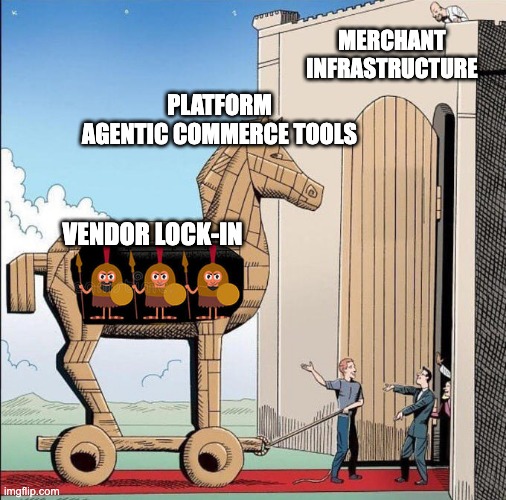
Several major platforms have announced support for ACP-style checkout products, including selling on ChatGPT and catalog synchronization. A key concern we consistently hear from merchants is the risk of vendor lock-in when adopting these solutions. Over time, this can mean being locked into a specific payment processor, losing the ability to bring your own risk or other vendors, or having to trust aggregators and platforms with the most sensitive parts of your operations (where the platform’s incentive to scale as a network can diverge from the needs of an individual merchant operating as a sovereign business).
This concern is exactly why we design our solutions with merchant sovereignty in mind. Merchants should know that even years from now, when this infrastructure may power critical parts of their business, they retain full control over payments, risk, data, and decision-making.
What’s Next?
The VC and tech industry debates which LLM will reach AGI first. Most people don’t care. They want to shop, travel, learn, dine, spend time with friends. The next major AI wave in 2026 will be consumer-facing, and it’s pretty clear OpenAI is positioning accordingly -investing in UI, ChatGPT Apps (the app marketplcae was released yesterday in Beta), delightful consumer experiences (recommended read: the latest Fidji Simo’s writing on the strategic role of UI in AI products).
Agentic Commerce will be a major theme in 2026. If you’re thinking about an offensive, agent-native strategy, we’re here to help.