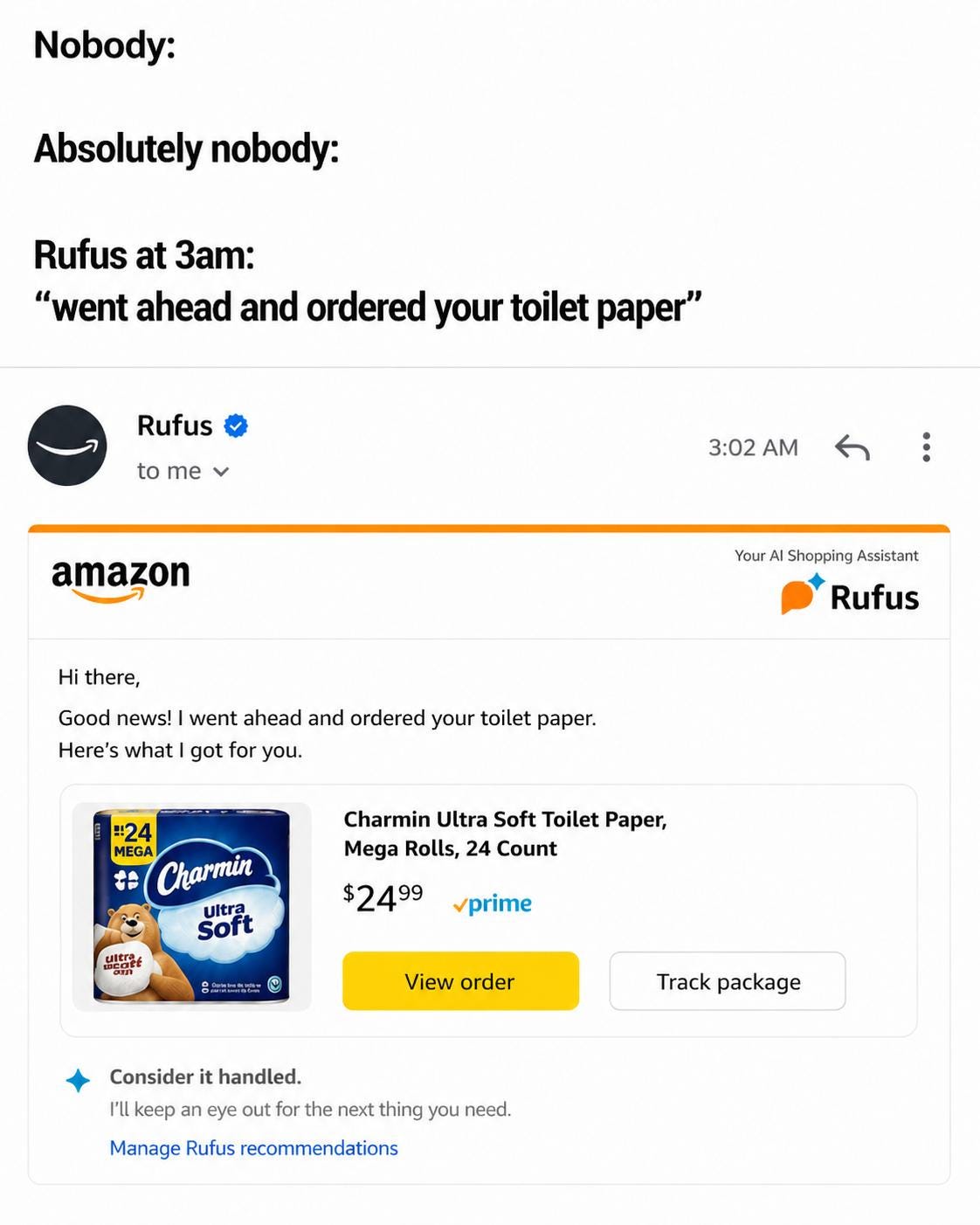
Lots of big news in agentic commerce lately, but we wanted to focus one specific thing that stands out - Amazon’s Rufus new agentic commerce features.
We’ve always been interested in how agentic commerce creates net-new behaviors, not just incremental improvements to existing flows like a “better search” (which is a bit what agentic commerce is right now via ChatGPT, Gemini etc.). This feels like one of those moments. So let’s break down what they released and why it matters.
Note - there’s also interesting news happening with Amazon joining the UCP alliance (Universal Commerce Protocol by Google). There’s solid coverage of this and Amazon’s strategy in Scot Wingo’s blog Retailgentic. TL;DR - they’re doing it to ensure they have the largest catalog coverage in the market, but definitely worth reading Scot’s strategic analysis.
Shopping while you sleep
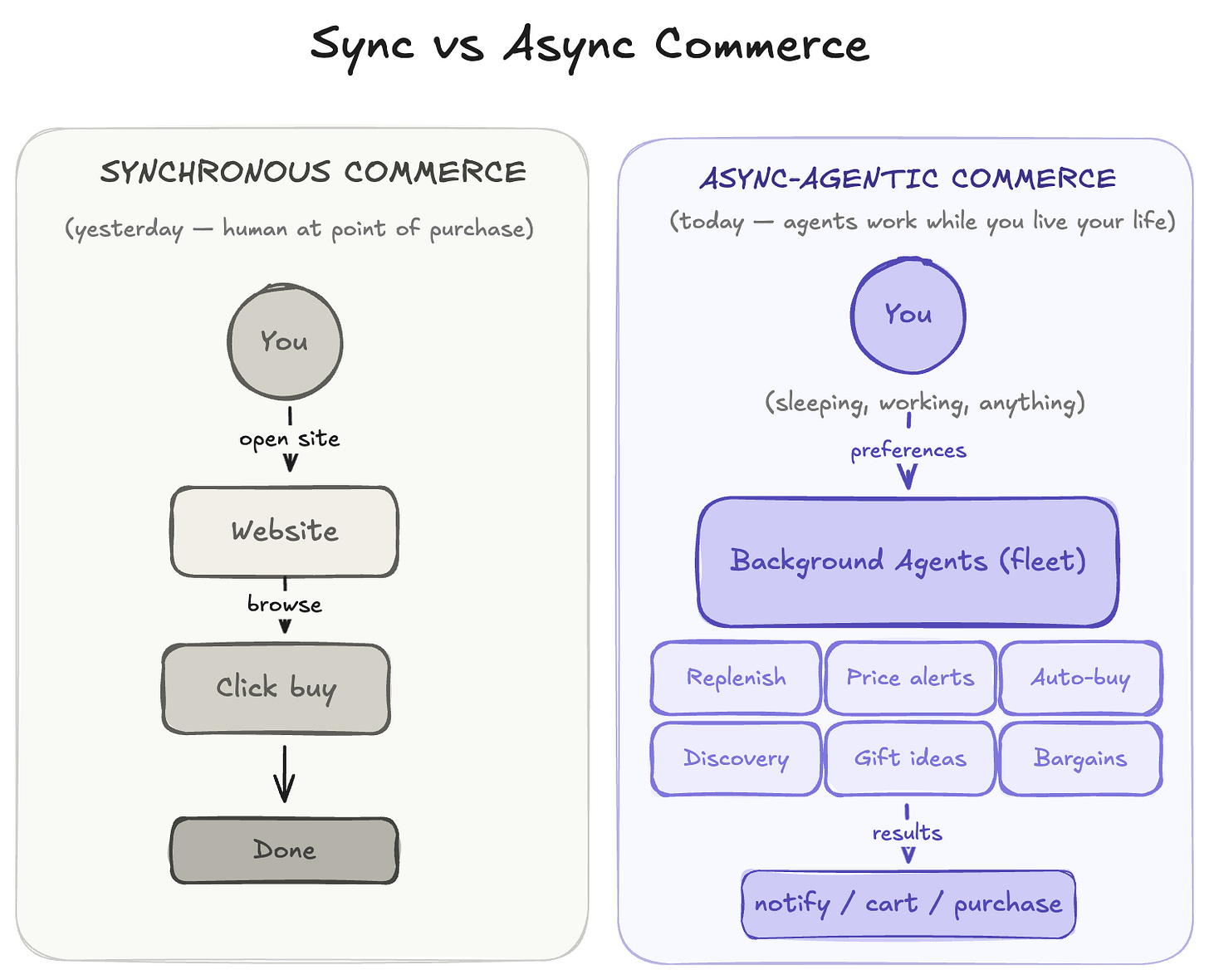
Today, when you buy something on the internet, there’s usually a synchronous process - you actively look for something on Google or Amazon, or maybe you see an ad, click it, and eventually purchase. But that journey almost always starts with you sitting in front of a screen.
Amazon recently launched a new feature in Rufus, their shopping assistant, called Scheduled Actions. As the name suggests, it lets you schedule asynchronous shopping actions. This is what you see on the scheduled menu on Rufus:
The idea is that Rufus acts as a background agent. You can set processes to run at any time - developers would call these cron jobs - that do work and report back.
For example, you could set a birthday reminder for family members and get gift suggestions alongside it. We already have reminders in our calendars - adding relevant suggestions on top of that is a natural next step.
We think of these as async agentic commerce behaviors, because the process runs asynchronously in the background. There have been versions of this on the internet before. For example, CamelCamelCamel lets you track price drops and get notified. But it never really went mainstream.
The reason is mostly technical. Setting these systems up reliably required effort and some level of technical understanding, plus ongoing engineering overhead. It was a double sided problem - most people won’t do that because they can’t configure and program services, and setting up these generalizable services was hard engineering wise.
The AI shift changes this. It becomes easy to configure these background agents and run them reliably behind the scenes. That’s what will drive an explosion of these types of services.
Core Async Capabilities
We mapped five main Rufus Async commerce capabilities:
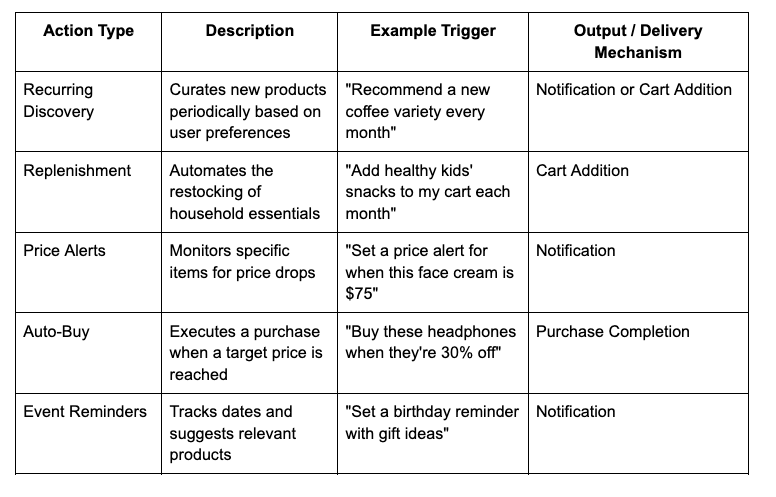
As an example, we like 3D printers. So we set up a service that tracks deals on 3D printers and sends notifications - both in the app and via email.
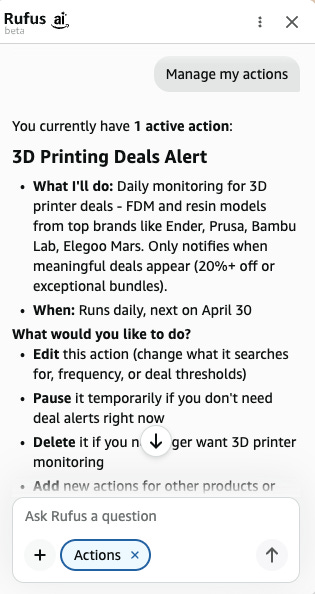
Action management
Users can manage their active async tasks by prompting, “Show my scheduled actions.” This command opens a management interface within the chat panel, displaying a summary of active actions (e.g., “You have 3 active actions running”) and offering options to edit, pause, or schedule new actions.
Moving from black and white to color
This shift feels like adding a new dimension to commerce. It’s not just doing the same flows better - it enables entirely new types of experiences and behaviors. Over time, that expands how often people engage, what they delegate, and how much commerce actually happens. Async commerce happens while you sleep.
Maybe in a few years, Rufus KPIs will look very different - things like “number of async agents running per user” or “notification-to-conversion ratio.”
The more users engage with these async agents, the more touchpoints Amazon creates. More notifications drive more interactions, which translate into more traffic and, ultimately, more revenue.
At the same time, this creates a new surface for competition - merchants are no longer just competing on search results or ads, but on who gets surfaced inside these ongoing, agent-driven interactions.
Amazon will educate the market
The core challenge with these new behaviors is trust. For this to work, users need to trust the system to act on their behalf, especially when it comes to purchasing.
Rufus has an advantage here because it’s wrapped in Amazon’s trust layer. You’re still buying from Amazon, a brand people already trust. That makes it a natural place to introduce and normalize these behaviors.
This is why we think the impact goes beyond just improving Amazon’s own experience. There’s a second-order effect - educating users to get comfortable with async commerce.
Once that behavior is learned, it won’t stay inside Amazon. It will move downstream to the rest of the ecosystem. We’ve seen this before with things like one-click checkout. Amazon pushed it, users got used to it, and eventually it became standard.
Async commerce likely follows the same path - it starts inside Amazon, but over time becomes a default pattern across e-commerce.